


5 Signs Your Beauty Brand Isn't Ready to Scale
A no-fluff clean beauty brand strategy guide for indie founders who want to know if their brand is truly ready for retail, scaling, and long-term growth or just built to launch.
You did everything right. So why does your beauty brand feel stuck?
You have a product you genuinely believe in. You spent time probably more than you'll admit on the formula, the label, the name. You pressed launch, held your breath, and watched the first orders trickle in.
And now you're here. A few months in, maybe a year. You're working harder than ever, but your beauty brand growth strategy isn't matching the energy you're putting in. Sales are inconsistent. Your engagement is decent but doesn't convert.
You've had promising conversations with stockists that went quiet. A retail buyer asked for more information and you weren't sure what to send.
There's a specific kind of anxiety that lives in this space not dramatic, not urgent, just a low hum in the background of everything you do.
A quiet question that keeps resurfacing:
"Is my brand actually built to last or did I build something to launch?"
If that sounds familiar, you're not alone. Almost every indie beauty founder hits this moment. The problem isn't passion.
It isn't the product. In most cases, it's a gap in how the brand is positioned, perceived, or prepared to grow.
A clean beauty brand strategy issue not a talent issue.
And those gaps are fixable. But only once you can actually see them.
Why brilliant indie beauty founders end up stuck and it's not what you think
Here's what I've watched happen across 15+ years working in the beauty industry at MAC, Bobbi Brown, Dior UK, and now through THINK, where I work with emerging clean beauty founders every day.
Most indie beauty founders get stuck not because they lack passion, talent, or even budget.
They get stuck because no one has ever shown them how the industry actually evaluates brands.
Not how their followers evaluate them. Not how their friends evaluate them. How the market evaluates them.
Retailers use specific criteria. Investors use specific criteria. Even consumers though they couldn't articulate it respond to signals that either build trust or erode it.
When those signals are misaligned, even a genuinely great product will stall.
The clean beauty founders I see breaking through aren't always the ones with the best formulas or the biggest budgets.
They're the ones who understand their brand's position with clarity who can speak to their differentiation without flinching, who've aligned their clean beauty brand pricing strategy to their perceived value, and who've pressure-tested their retail readiness before ever sitting across from a buyer.
This is exactly what the Brand Viability Scorecard is designed to surface.
The five pillars that determine whether a beauty brand has a strong foundation or a fragile one.
And below, I've broken down the five most common signs that one or more of those pillars needs work.
Read these as an honest brand audit not a verdict. Every brand has gaps. The ones that grow are the ones that name them.
The 5 Signs Your Beauty Brand Isn't Ready to Scale And What to Do About Each One
1. Your clean beauty brand positioning could belong to any brand in your category
Open your brand's about page right now. If the words "clean," "effective," and "sustainable" appear in the first paragraph, you have a description not a position.
Clean beauty brand positioning is not a tagline and it's not a mission statement. It is the specific, irreplaceable place your brand occupies in your ideal customer's mind.
It answers one question with sharp precision: why you, and not the other 47 brands that launched this year with a very similar product?
The hard truth is that most indie beauty brands are differentiated on product a hero ingredient, an innovative texture, a longer list of excluded "naughty list" ingredients.
But product differentiation alone is increasingly thin protection in a market where a dupe can appear on a mass platform within six months of your launch.
Durable clean beauty brand differentiation is built on the intersection of what your brand genuinely does better, what your specific customer deeply cares about, and what no competitor is claiming with the same conviction.
It should feel a little uncomfortable to say out loud specific enough that some people immediately feel excluded.
If your current positioning could be copy-pasted onto a competitor's website without anyone noticing, you don't have a position. You're blending in. And in the clean beauty market, blending in is expensive.
The fix: Complete this sentence and resist the urge to soften it: "We're the only beauty brand that [specific claim] for [specific customer] who [specific tension or desire]."
If you can't fill in the blanks without using generic clean beauty language, keep digging. The discomfort is where your real differentiation lives.
2. You've Never Formally Checked If Your Clean Beauty Market Timing Is Right
Here's a question most founders have never formally asked: is the market actively moving toward your category right now, or has it already peaked?
Clean beauty market timing matters more than most people want to admit.
Launching a pore-minimising serum into a saturated subcategory is a very different proposition to launching in a space with rising search volume, increasing editorial coverage, and a gap in the premium tier.
One is brave. The other is expensive.
Demand signals aren't just about whether people buy your product.
They're early indicators of market momentum the direction the category is travelling, whether your specific clean beauty brand positioning sits in front of or behind the trend, and whether there's a real gap at your intended price point or whether you're competing for the same shelf space as a dozen well-funded competitors.
This is one of the hardest things for beauty founders to assess independently, because it requires looking at the market objectively rather than through the lens of your own enthusiasm for what you've built.
That enthusiasm is an asset in almost every other context. Here, it can actively obscure what you need to see.
What makes this even more nuanced is that demand can be real and rising and still represent a timing risk if the trend is late-stage, you might be catching it on the way down rather than the way up.
Beauty brand viability is as much about timing as it is about quality.
The fix: Run a proper demand audit before your next product decision or marketing investment.
Check Google Trends for your hero ingredient or core claim over a 24-month window. Look at TikTok search volume. Pull Mintel or Euromonitor data on your subcategory if you can access it.
And crucially look at who else is in this space and when they entered. If the big players are already there, you need a tighter positioning or a different angle of entry.
3. Your Packaging Looks Indie And Not In The Way That Builds Authority
Shelf presence isn't about aesthetics. It's about authority.
In the clean beauty space, "indie" can communicate two very different things.
It can signal handcrafted, intentional, and premium the kind of brand a discerning customer feels clever for discovering.
Or it can signal unfinished, under-invested, and fragile the kind of brand a retailer passes over without a second glance.
The difference between those two readings is usually not the design concept. It's execution: the weight of the stock, the quality of the print, the hierarchy of information on the label, the way the typography sits on the surface.
These are not small details. They are the brand's first and sometimes only argument for its own value.
Here's the uncomfortable part: customers might not tell you when packaging is working against you.
They'll scroll past. Or they'll pick it up in store, feel uncertain, and put it down. Retailers, on the other hand, will make an instant, experienced judgement about whether your packaging can hold its own on a shelf next to established brands and most will not take the time to explain why they passed.
Packaging is also a major lever on perceived price point. A $45 moisturiser in packaging that reads $22 creates cognitive dissonance at the checkout.
Customers sense the misalignment even if they can't name it and doubt, in beauty, almost always resolves in favour of the established alternative.
This is a common reason clean beauty founders find their brand stuck not growing despite a strong product.
The fix: Do a physical shelf audit.
Purchase products from three competitors positioned at the price tier you're targeting ideally brands at the level you aspire to reach, not where you currently sit.
Put them on a table and place yours alongside them. Ask: does this belong here? Then ask someone who doesn't know your brand to answer the same question. Their hesitation is your creative brief.
4. Your Beauty Brand Pricing Strategy Is Doing The Maths But Not The Marketing
Pricing is one of the most underused brand signals in the indie beauty space. Most founders arrive at their price point through a logical process: cost of goods, plus margin, plus a look at what competitors are charging. It's a reasonable starting point.
But it's not a beauty brand pricing strategy.
A pricing strategy accounts for what your price point communicates about your brand independently of what the product costs to make. Price is a signal. It tells customers where you sit in the hierarchy of the market.
It sets expectations about quality, experience, and who the brand is for. When it's misaligned with every other signal your brand is sending, it creates a friction that's almost impossible to diagnose if you're only looking at conversion rates.
The most common pricing errors I see in clean beauty aren't about being too expensive. They're about misalignment. A brand with a luxury editorial aesthetic, premium ingredients, and sophisticated packaging priced at $18 trains customers not to take it seriously.
A brand with modest packaging and a limited brand story priced at $65 triggers scepticism that no amount of social content will ever overcome.
Price also determines which retail partnerships are structurally possible. If your RRP isn't high enough to accommodate the margin expectations of the retailers you're targeting, no amount of relationship-building will make the numbers work.
Pricing decisions made at launch have a long tail and they're much harder to correct than most beauty entrepreneurs anticipate.
The fix: Map every customer touchpoint from your website, packaging, social content, email tone, photography and ask whether each one reinforces the same price tier.
Then model out whether your current RRP can support your target retailers' margin requirements plus your own.
If either question creates tension, that tension is the work. A proper beauty founder brand audit starts here.
5. You're Not Sure Your Brand Is Retail-Ready And If You're Honest, Neither Is The Buyer
Retail readiness is not a finishing line you cross when you feel confident. It is a set of objective, assessable criteria that retailers evaluate every brand against and most emerging founders have never had those criteria clearly laid out.
If you've been asking yourself "how do I get my beauty brand into retail?", the answer starts long before the pitch.
The basics are well known: barcodes, regulatory compliance, a coherent sell sheet, adequate stock capacity. But beauty brand retail readiness at the level that actually opens doors goes well beyond logistics.
It includes whether your claims are substantiated and defensible, whether your brand story is compelling in ten seconds, whether there is evidence of existing consumer demand not just founder enthusiasm and whether your pricing structure works for the retailer's margin model without destroying yours.
It also includes something less tangible but equally important: does your brand look like it belongs next to the other brands in the retailer's current assortment?
Not identical adjacent. Buyers are curators. They are imagining the shelf, the customer journey, the category story they're telling.
Your brand needs to fit that story and add something to it.
Many founders wait until they have a retail lead to start thinking about retail readiness. By then, the gaps are expensive to close quickly and the opportunity may not wait.
The founders who consistently convert those conversations into listings are the ones who built their beauty brand retail readiness checklist before the buyer ever called.
The fix: Build your retail readiness checklist now, before you need it, so you're prepared to sell.
Include: certifications and compliance documentation, substantiated claims, a polished sell sheet with product imagery, press or editorial coverage (even early-stage), your margin structure modelled at 4055% trade discount, MOQ clarity, and a one-paragraph brand story written from the buyer's perspective not the founder's. Identify every gap and assign a realistic timeline.
What Changes When You Finally Have Honest, Strategic Clarity
There is a particular quality to the confidence that comes from strategic clarity and it's different from the optimism you feel when you believe in your product, or the temporary reassurance of a strong sales week.
Strategic clarity is quieter. It's less about enthusiasm and more about direction. When you know with specificity where your brand is strong and where the gaps are, you stop spending money and energy in the wrong places.
You stop second-guessing your beauty brand pricing strategy because you understand what it's communicating. You stop posting more content hoping something will land, because you know the problem isn't volume it's clean beauty brand positioning.
You also start having different conversations.
Conversations with retailers where you know exactly what they're evaluating and how to show you meet their criteria. Conversations with investors where you can articulate your market opportunity with confidence.
Conversations with yourself where the next priority is clear, not overwhelming.
This is the shift the Brand Viability Scorecard is designed to create. Not a verdict on whether your brand is good or bad.
Not a list of generic beauty entrepreneur advice you could find anywhere.
A precise, personalised picture of where your brand stands right now across the five pillars that determine whether an indie beauty brand breaks through or blends in.
"It's not about perfection. It's about knowing where to focus next."
Most founders who complete the scorecard discover one or two specific gaps they hadn't named gaps that, once visible, immediately clarify the next move.
That moment of clarity, however uncomfortable, is worth more than months of incremental effort pointed in the wrong direction.
Here's Exactly What You Walk Away With From The Brand Viability Scorecard
The Brand Viability Scorecard is a fast, founder-friendly beauty brand audit tool that takes about five minutes to complete. No complicated worksheets. No preparation required.
Just honest answers to a focused set of questions designed to surface the signals that actually matter.
Within 48 hours, you receive a personalised video breakdown covering all five brand pillars; Positioning, Differentiation, Demand Signals, Trend Alignment, and Growth Opportunity with a traffic-light status showing exactly where your strengths are and where the blind spots live.
This isn't an automated quiz result. Every scorecard is reviewed by an experienced beauty brand strategy consultant who has worked inside the industry at MAC, Bobbi Brown, and Dior UK and who understands how brands are evaluated from the inside.
The feedback is intentional, specific, and actionable. It applies the same criteria used by retailers, investors, and category analysts not vibes, not general encouragement, not advice every beauty entrepreneur has already heard.
Here's what you'll walk away with:
A detailed breakdown across all five brand pillars, so you can see the full picture at once
A traffic-light status showing exactly where you're strong and where refinement is needed
A tailored next-step action list based specifically on your results not a generic checklist
Clarity about the one or two gaps most likely to be slowing your growth right now
The same evaluative lens that retailers and investors use applied directly to your brand
Whether you're still shaping your idea, preparing for launch, already selling and feeling stuck, or considering retail or scaling the Brand Viability Scorecard works.
The fundamentals of clean beauty brand viability don't change with the stage of your business. The questions get more complex, but the pillars are the same.
You don't need a million-dollar budget to build a beauty brand that stands out.
You need the right direction given at the right moment, based on an honest assessment of where you actually are.
That's what this is.
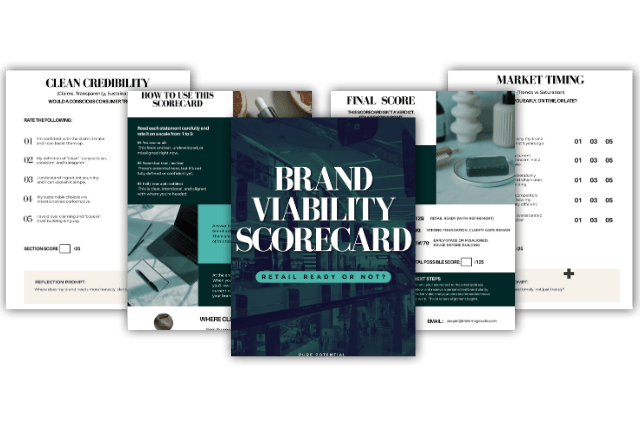
Brand Viability Scorecard
Results delivered within 48 hours.
No Fluff. No shame. No guesswork.
©THINKMAGSTUDIO 2025